
Guide to New Jersey Divorce Records
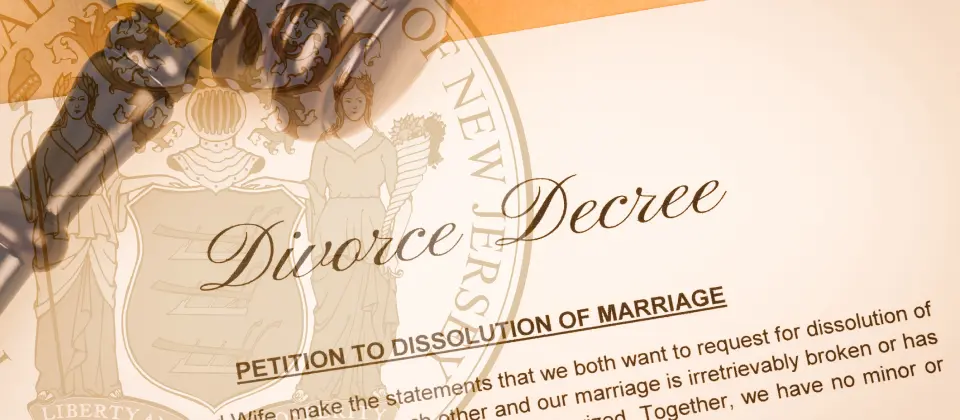
Divorce regulations and access to court records vary from one state to another. Divorces in New Jersey are legal proceedings conducted through the state court system and result in documentation that officially ends a marriage.
A divorce action begins in New Jersey when one spouse files a complaint for divorce in the Family Division of the Superior Court, in the county where either spouse resides. As the case progresses, a number of legal documents, motions, and orders will be created by the court. These documents constitute the official divorce record for legal and administrative purposes.
Although the amount of detail may vary depending on the type of record requested, a typical New Jersey divorce record may include:
Names of both spouses involved in the divorce
The county where the divorce complaint was filed
The court division that handled the case
Date the divorce judgment was finalized
Case or docket number
Court decisions involving child custody, parenting time, child support, alimony, and property division
Type of judgment issued (contested or uncontested divorce)
New Jersey property distribution laws utilize equitable distribution in dividing property. When deciding custody and parenting arrangements, the paramount concern of the court is the best interests of the child.
New Jersey divorce records are maintained by the county and state. Older divorce cases may be limited to their paper files or stored in a court's archive, while newer divorce cases are usually kept in the electronic systems used by the courts. Based on the record type, you may access the record through the court offices or authorized state services. However, certain sensitive details in divorce records may be unavailable for privacy reasons.
Knowing how divorce works in New Jersey-and how issues like property division and custody are handled-can make it easier for you to locate and request the correct divorce records when conducting legal, personal, or criminal history research.
What are New Jersey Divorce Records, and How Do They Work?

In New Jersey, divorce records are court-issued documents that legally dissolve a marriage. It provides evidence that a marriage union has been officially terminated under state law.
Some people mistake divorce records for marriage records, but the two serve very different purposes. A marriage record indicates that a legal union has taken place, while a divorce record shows that a legal marriage between two individuals has been terminated. Furthermore, divorce records indicate how the property and financial matters were decided, as well as matters of parental responsibility.
Under New Jersey law, divorce records consist of documents produced by the court in a marriage termination proceeding. When a spouse files a divorce complaint with the Family Division of the New Jersey Superior Court, divorce records are created.
Documents commonly considered part of a divorce record include:
Divorce complaint or petition
Summons and court filings
Settlement agreements
Motions and court orders issued during proceedings
Final Judgment of Divorce (the official document ending the marriage)
Where are New Jersey Divorce Records Stored?
In New Jersey, divorce records are kept at the county and state levels. The level of information you need will influence where you have to go for these records.
Divorce records in New Jersey are maintained at the county level by the Superior Court in the county that granted the divorce. Usually, these records contain the filings, motions, court orders, and final divorce judgment, and are typically kept by the court clerks.
At the state level, the New Jersey Department of Health (Office of Vital Statistics) can provide you with information on divorce cases as it operates a statewide divorce index. These indices come from reports that the county courts submit and typically serve as summaries of the fact that the person was divorced. However, this office do not issue divorce certificates or decrees. They can only confirm whether a divorce took place.
Is New Jersey a 50/50 Divorce State?
No. In New Jersey, divorce isn't a 50/50 split state. Rather, it is an equitable distribution state, meaning that the court will divide property based on what is fair. The judge will consider several factors to decide how the assets should be divided. This usually depends on the nature of the marriage and on each spouse's contributions during the marriage.
According to New Jersey Statutes 2A:34-23.1, marital property is to be distributed in a fair and just manner, taking into consideration the facts and circumstances of the couple during a divorce.
The principle of equitable distribution stipulates that the couple's assets and debts should be divided fairly, but not necessarily equally. In reality, a 50/50 split may happen sometimes, but the court is usually not going to divide property this way. Instead, the court will divide the property based on each person's contribution to the marriage and the parties' relationship.
New Jersey courts usually consider the following when dividing property in a divorce.
Length of Marriage: When couples divorce, the division of assets depends on the length of the marriage. Assets in longer marriages are divided more equally than in shorter marriages.
Income and Earning Capacity: The spouses' current income and future earning capacity are considered by the court. A spouse with a lower earning capacity may be given a larger share.
Each spouse's contribution: The court will consider each spouse's contributions to the family, including non-financial contributions, such as raising children or assisting a spouse in their employment. A spouse who stayed at home to take care of the family might get a bigger share of the marital assets.
Marital vs. Separate Property: Property that is acquired during the marriage is marital property and subject to division. Property owned before the marriage or that was received as a gift or inheritance will be separate property and not subject to division.
Fault Considerations: New Jersey is a no-fault divorce state, but if either party's misconduct has adverse effects on the finances or well-being of the family, the court may still consider it.
Types of New Jersey Divorce Records

Different types of divorce records have different legal and personal functions. While some records just state that a divorce took place, others have all of the legal terms that determine the rights as well as responsibilities of both former spouses after the marriage officially ends.
In New Jersey, divorce records are split into separate categories so people, government agencies, and courts can only access the level of information they actually need.
You may need a divorce certificate if you wish to change your marital status for purposes such as name change, remarriage, government records, insurance companies, etc. In contrast, if you need to enforce the terms of a custody arrangement, prove the property division terms, or resolve support obligations that the court outlines, you normally will need your divorce decree.
The following are the types of divorce records in New Jersey:
New Jersey Divorce Certificate (Certificate of Divorce)
A Divorce Certificate, also known as a Divorce Certificate, is issued through the New Jersey Superior Court. Unlike some states, where divorce certificates are issued through the Vital Records Section of the Department of Health, in New Jersey, they are issued by the Superior Court.
The document contains a summary of the divorce, not the actual ruling of the court. It usually includes the names of both spouses, the county where the divorce occurred, and the finalizing date of the divorce.
A divorce certificate is not very detailed; hence, it cannot be used in place of a court decree, as it does not include any order or settlement terms issued by the court. It basically serves as proof that the marriage was legally dissolved in New Jersey.
Generally, it is used in applications for remarriage, to change name, to declare marriage status, for identification and criminal background checks, or for administrative or personal use.
Divorce Decree (Final Judgment of Divorce)
The Divorce Decree (Final Judgment of Divorce) is the most authoritative state document regarding divorce. A divorce decree documents the formal and legal end of a marriage. It includes the court decisions and all issues that were litigated during the case.
This is a document issued by the New Jersey Superior Court in the county where the divorce was filed. Unlike the certificate, the decree comprises the court's full adjudications and binding orders on the parties, including:
Property and Debt Division: A divorce decree clarifies how the couple's marital property and debts are divided between the two parties.
Alimony: It details the amount, duration, type, and conditions of spousal support if the court allows it.
Separation Agreement: This document covers important details regarding your children's legal custody, parenting responsibilities, and support obligations.
Final Judgment Date: The judgment date is the date the judge signed the decree dissolving the marriage.
Through the legal rulings contained in a New Jersey divorce decree and the authority the document carries, both parties can formally enforce court-ordered obligations such as alimony, child support, or custody arrangements if disputes arise after the divorce.
How to File for Divorce in New Jersey (Step-by-Step)
Unless in rare fault-based situations like adultery, at least one spouse must have lived in New Jersey for one year before filing for divorce. Per the New Jersey Statutes Annotated § 2A:34-10, the court can only hear a divorce case when these residency conditions are satisfied.
Essentially, you cannot file immediately after moving to New Jersey unless the residency timeline has been met. This is ultimately because the court must confirm it has jurisdiction over the marriage.
Before filing paperwork, you and your spouse need to identify whether the divorce will be uncontested or contested, since this decision largely determines how long the process may take, how expensive it becomes, and how much court involvement will be required.
Uncontested Divorce: When you and your spouse agree on the major issues that are usually contested in a divorce before filing, the divorce is uncontested. Usually, you and your spouse will need to reach an agreement on the division of marital property and debts, alimony (if applicable), child custody and parenting arrangements, and child support.
Since uncontested divorces do not involve a dispute for the judge to resolve, they are generally less complicated and go through the system faster. Lots of couples go down this route so that they can take some control over decisions concerning either their finances or the children, as opposed to letting the court entirely decide the matter.
Contested Divorce: In a contested divorce, you and your spouse disagree on one or more important issues, such as custody arrangements, financial support, or how assets should be divided. When this happens, the case has to go through the courts, where there is an exchange of financial information (discovery), court conferences and hearings, mediation attempts, and trial if agreements cannot be reached.
Because the judge resolves unresolved issues in accordance with New Jersey law, contested divorces take longer and may be more costly. Once a court order is issued, both spouses must comply with the court's decision. Even if one spouse disapproves of the ruling, the court.
Once you have decided whether your divorce is contested or uncontested, and you or your spouse meets the state residency requirement, the next stage involves preparing and officially filing your case with the court. You can follow the steps below to file for divorce in New Jersey.
Step-by-Step Divorce Process
The procedure for divorce in New Jersey may vary slightly by county and by whether the divorce is contested or uncontested. However, in most cases, the filing procedure is essentially the same.
Prepare the Filing Packet
Before opening a divorce case, you will need to gather and organize the documents required by the New Jersey Superior Court, Family Division. This stage is important as it lays the foundation for your case, so accuracy and completeness matter.
At this stage, you should:
Identify the Divorce Path (Uncontested vs. Contested): You and your spouse decide on all major issues or get the court involved to settle unresolved issues.
Prepare the necessary documents:
Divorce Complaints: The complaint for divorce starts the case, sets forth the grounds for the divorce (for example, irreconcilable differences), and requests.
Certification of Verification and Non-Collusion: A statement that all information in the file is true and that the divorce is not a sham. Assures the divorce is not rigged by the parties.
Summons: Informs your spouse officially.
Confidential Litigant Information Sheet: The document contains sensitive details like Social Security numbers.
Case Information Statement: A detailed and compulsory document outlining income, expenses, assets, and debts.
Certificate of Insurance Coverage: Confirms health/life insurance status of both parties.
CDR certification: States that you have been alerted about your options for dispute resolution.
You may be required to submit additional documents, including a marriage certificate copy, proof of New Jersey residency (minimum one-year residency requirement, except adultery-based filings), and child custody or parenting documentation, where applicable.
Filing fees and fee waivers (Indegency): New Jersey courts charge a divorce filing fee of around $300. There is an additional $25 fee if you are requesting child custody or parenting time. If you can't pay the filing fee, you can ask to have it waived by filing a Fee Waiver Form. The court will review your finances and may waive the required fees.
File the Case
Once you have your paperwork finished and the necessary filing fee ready, you can file your divorce case with the court.
Where to File
File your completed divorce packet with the Family Division of the New Jersey Superior Court in the county where either spouse currently lives. Generally, filing takes place in the county of residence of the spouse filing or where the other spouse resides.
Filing Methods
You can file your divorce case through one of the following methods, depending on the county and your personal preference.
In-person: You can bring your completed forms and filing fee directly to the Superior Court Family Division office in the appropriate county. After reviewing it for basic filing requirements, the court staff will officially accept the case.
Mail: Some county Family Division offices accept divorce filings by mail. When filing this way, you must include all required documents along with payment for filing fees, and you must include a self-addressed stamped envelope in which the court can return filed copies.
Electronic filing: New Jersey permits divorce cases to be filed via the Judiciary's electronic filing system (eCourts). You can file your papers, pay your filing fees, and get your court notices without going to court.
What You Will Receive
With these documents, the divorce process officially begins, allowing the spouse who will file the divorce to serve the other party and proceed with the New Jersey divorce process.
Following the court's acceptance of your paperwork, you will receive:
Your divorce case will be assigned a docket (case) number to help you reference it as needed.
A summons must be served on the other spouse to give them notice that a divorce action has been taken.
The initial notice from the court outlines the deadlines and next steps in the case.
With these documents, the divorce case is officially started. The spouse who wishes to file for divorce may serve the other party and proceed with the New Jersey divorce process.
Service of Process (Contested Cases)
Once a divorce case is filed in court, the next step is service of process. In New Jersey, the New Jersey Superior Court recognizes approved methods of service to deliver divorce papers. The most common service techniques are.
County Sheriff's Office
Private process server
Certified mail
After the delivery of divorce papers, you must submit proof to the court that the other party has been served. However, if you cannot locate your spouse, New Jersey courts will allow alternative service methods, especially if you can prove reasonable efforts to find the spouse
For example, you can send the papers to your last known address or publish the notice in an approved newspaper, known as service by publication, but you have to prove your efforts to locate your spouse.
Early Case Phase and Temporary Orders
The early case phase is the stage of a New Jersey divorce that begins shortly after the papers are filed and served and continues while the case is still pending before the court. During this time, the marriage is still legal, but in fact, separation may already be happening.
As no final decisions have been made, the New Jersey Superior Court expects each spouse to maintain the status quo and refrain from conduct that would unfairly disadvantage the other spouse or their children.
During this phase, informal expectations, temporary court orders, and practical 'status quo' rules generally apply.
Temporary Custody and Visitation: If children are involved, to maintain stability and order for your children, the court will issue temporary custody and parenting time orders.
Temporary Child and Spousal Support: The court may order temporary financial support to meet the basic needs of the children and may order temporary alimony to shield one spouse from sudden hardship. The sums mentioned are only temporary and will be amended later, after the full review of the parties' finances.
Exclusive Use of Marital Home: The court may permit either party to live exclusively and temporarily in the matrimonial home, particularly in situations where it is deemed impractical and/or unsafe for the parties to live together during the divorce.
If a spouse feels there will be harassment, a threat, or conflict when going through a divorce, they can file for a protective or restraining order. Restraining orders may limit spouses' contact, access, and communication to protect the person making the restraining order or prevent interference with the divorce process.
When divorce proceedings commence, courts try not to disturb the couple's current living, monetary, and parenting situations. As far as possible, it's important to keep things the same, including your children's schooling, insurance, and household payments, to reduce disruption, especially with kids involved. Even though temporary, these arrangements can affect the final agreements.
Financial Disclosures and Discovery
In a New Jersey divorce, the discovery process ensures that both you and your spouse have access to all the financial information needed for fair decisions on property, support, and alimony. Both parties are required to provide full and honest disclosures on their finances so that the court-and each spouse-can make informed decisions based on the true picture of the family's finances.
In New Jersey, financial disclosure involves:
Mandatory Disclosure: Each spouse must provide a detailed financial statement that specifies their income, monthly expenses, assets, and debts accurately. The courts require accurate disclosure. If you fail to disclose an asset or you misrepresent your finances, it can affect how the courts divide your property, the amount they approve as support, and their final decision.
Supporting Documents: Both spouses must submit supporting documents such as pay stubs, tax returns, bank statements, loan documents, and investment or insurance records.
Discovery Tools: When one spouse disagrees with any of the information provided or wants more details, New Jersey divorce law allows for discovery tools-legal methods a spouse can use to gather more information.
Requests for Documents: Here, one spouse can request specific records from the other spouse. Such documents include account statements, bills, or contracts from the other spouse.
Interrogatories: One spouse sends written questions to the other, who must answer them under oath. The questions can cover their finances, employment, or business ownership.
Subpoenas: A subpoena is a court order that allows the court to obtain documents or testimony from third parties, such as banks, employers, or accountants.
Depositions: Both spouses and sometimes experts and witnesses are questioned in front of a court reporter. They can be questioned in detail about their finances, assets, or other relevant matters.
Case Management and Court Conferences
Once a divorce case has been filed, served, and the initial financial disclosures completed, the court moves into case management.
A case management conference is usually the first formal court meeting after a divorce is filed. In this short hearing, a judge or other court staff member will review the financial disclosures, which you and your spouse are required to file. They will check whether any temporary orders are currently in place and set deadlines for exchanging documents, mediation, or other discovery, as well as dates for other filings.
If a divorce remains contested, a pretrial conference occurs closer to the date the case might go to trial. During a pretrial conference, the judge usually:
Reviews any unresolved issues (custody support, alimony, property division)
Confirms that discovery has been completed
Discusses whether a settlement is possible or mediation is appropriate
Schedules trial dates if no agreement is reached
Settlement or Trial
Most divorces in New Jersey are resolved through settlement rather than trial, where the parties agree on all relevant issues and provide the court with a written contract of the settlement. Some common settlement approaches in New Jersey include:
Direct negotiation where spouses reach agreements on key issues
Mediation through a neutral third-party professional
Attorney-led negotiation settlements
If negotiation fails and a settlement becomes impossible because you and your spouse failed to agree on issues such as child custody, child visitation, or property division, the case goes to trial, where a judge makes the final decisions. At trial, the following occurs:
Evidence and witness presentation from both sides to support their claims
The judge issues proposed findings of fact
The final judgment, which aims to resolve all unresolved issues and divide the marital assets equitably
Judgment, Waiting Periods, and Finalization
A divorce in New Jersey can be final without a cooling-off period. Once everything is in order and the judge verifies that the service, financial disclosure, and settlement or trial have been completed properly, the final judgment of divorce will be signed immediately.
The time it takes to get your divorce decree depends on the court's workload and your individual circumstances, rather than a law that states you have to wait a certain number of days.
Child Custody and Child Support in New Jersey Divorces
When there is a divorce with children in New Jersey, the courts try to protect the child's best interests in the long term. Judges do not reward or punish either parent with custody or support. Instead, they try to make parenting choices that will enable children to feel safer, supported, and emotionally secure after the divorce.
The ability of each parent to communicate and cooperate
A child's connection and association with each parent
How stable and supportive each parent's home is
Which parent has primarily looked after the child in the past
Any issues or history of safety conflict
The child's needs and, sometimes, their preferences, depending on age
Legal Custody vs. Physical Custody
In New Jersey, child custody may be legal or physical.
Legal Custody: The parent with legal custody can make important decisions regarding the child, including education, medical care, religion, and general well-being. The courts generally give parents joint legal custody, meaning both will make these important decisions, even if the child lives mainly with one.
Physical Custody: Physical custody refers to where the child lives most of the time and how time is shared between both parents. In certain families, children spend time with both parents at their respective homes. In other families, however, the child lives primarily with one parent. That parent follows a parenting schedule that sets times for the other parent to have the child on weekends, holidays, and school breaks.
Child Support Guidelines and Enforcement
After the divorce, both parents are supposed to support their children financially through child support. New Jersey enforces statewide Child Support Guidelines based upon a formula which considers:
Both parents' income
Number of children
Parenting time arrangement
Childcare expenses
Health insurance costs
Once a court orders child support, it is no longer a voluntary payment and instead a mandatory payment. When payments are missed, New Jersey has strong enforcement options, including.
Withhold wages directly from pay
Interception of tax refunds
Suspension of driver's or professional licenses
Liens against property or bank accounts
Court enforcement actions
Property, Debt, and Alimony in New Jersey Divorces
New Jersey distinguishes between marital property and separate property:
Marital property includes anything acquired by either spouse during the marriage, such as the family home, retirement accounts, vehicles, or any investments purchased together, and income earned during the marriage.
Separate property is any item belonging to one spouse prior to marriage or one that is provided as a gift or inheritance to one spouse only. This could be property owned before marriage, or a gift or inheritance given to one spouse.
Just as assets must be divided, all debts, such as mortgages, credit cards, or car loans, incurred during the marriage, must also be addressed and shared in the divorce. The courts consider:
Whether the debt was used for marital needs
Who incurred the debt
Each spouse's ability to repay
Alimony or spousal support helps the lower-earning spouse maintain a standard of living after a divorce that is similar to what the couple enjoyed during the marriage. Several types are recognized in New Jersey.
Periodic Alimony: It is paid regularly, usually every month, for a fixed or indefinite period.
Rehabilitative Alimony: It is a temporary alimony used to help one spouse attain independence through education or acquiring a skill.
Lump-Sum Alimony: It is either paid as a single payment or deferred over the next few years.
Errors, Omissions, and Corrections in New Jersey Divorce Records
Common errors and omissions in divorce information may include misspellings, incorrect dates or financial information, or vague custody details. Mistakes in one's divorce decree may create problems down the line, when it comes time to apply for benefits, change an existing legal identity, remarry, or deal with property and finance issues. Therefore, if you find an error in your divorce judgment or associated documents, you must get it rectified as soon as possible to keep the documents valid and effective.
You can correct clerical errors in your divorce record by sending a written request and documents that support the correct information to the clerk of the Superior Court in the county where the divorce was granted.
If you discover errors or omissions in your divorce decree, you can file a formal motion with the same court. The judge will look at your request to determine whether the correction would reflect the court's intent or correct an error, rather than change the divorce agreement. In some situations, the court may require you to attend a hearing before they'll approve the amendment.
Once the judge approves the correction and amends your official divorce records, you can obtain a new certified copy of your divorce certificate or decree from the Superior Court Clerk's Office in the county of your divorce.
How to Access New Jersey Divorce Records

You can access New Jersey divorce records as follows:
Online Access
The fastest way to obtain proof of divorce in New Jersey is by ordering a Certificate of Divorce online through the New Jersey Office of Vital Statistics and Registry, the state's authorized service provider. You can submit requests at any time by providing valid identification, paying the fees, and providing basic divorce details to locate the record. Requests submitted online are usually processed more quickly than applications sent via mail.
In-Person Request
After the finalization of your divorce, if you need a full final judgment of your divorce case, you should request the document in person from the Superior Court, Family Division in the county where the divorce was filed.
In New Jersey, divorce records are kept in the county Superior Court system. To get the decree in person, you may go to the Family Division or Records Office of the court. Provide the names of the parties, approximate year of divorce, county, case number if known, and identification. You'll typically need to pay a copy and certification fee of about $20.
Mail-in Request
Divorce records can also be requested by mail through the Superior Court Clerk's Office. You must submit a completed records request form along with the spouses' names, county, and approximate divorce year, and the docket number if available. Attach a copy of valid identification and a check or money order. Ensure you give the court your contact details so they can notify you of updates on your request.
New Jersey Courthouses That Handle Divorces
When you seek a divorce in New Jersey, it is important to know which court hears divorce cases, where you will file your divorce, and where you will request divorce records, if you want copies.
Court Authority
In New Jersey, all divorces are handled by the Superior Court, the state's main trial court. Divorce cases fall under the Family Division, which also handles child custody, support, alimony, property division, and other family matters. This unified system ensures that divorce laws are applied consistently across the state.
County-Based Filing
Although the Superior Court covers all of New Jersey, divorce cases are filed and handled in the county where either spouse lives. Each county has a courthouse where Family Division cases are managed. For example:
A resident living in Newark files in Essex County Superior Court
Someone living in Jersey City files in Hudson County Superior Court
A resident of Toms River files in Ocean County Superior Court
Jurisdiction Basics
In New Jersey, the Superior Court, Family Division is responsible for divorce and other family law-related matters, including child custody, alimony, and division of marital property. Only the superior court in the state has the authority to grant a divorce and issue a final decree of divorce.
Examples (Optional, Not Exhaustive)
Every county in New Jersey has a Superior Court handling divorces. Examples include:
Role of the Circuit Court Clerk
The role of the Superior Court Clerk in New Jersey includes:
They accept and record divorce filings,
Preserve current and archived divorce records
Process requests for certified copies of divorce certificates.
They also guide you on submitting forms, paying fees, or requesting records
Help you access older cases stored off-site
FAQ
Are Divorce Records Public in New Jersey?
Yes, divorce records are public records in New Jersey per the New Jersey Open Public Records Act. Anyone may request copies of divorce records.
What is the difference between a certificate and a decree?
A divorce certificate serves as verification of a couple's divorce. It will state the names of the husband and wife, the date of the divorce, and the county in which the divorce occurred. A decree has the complete legal files of everything recorded during the divorce, from properties and child custody to alimony.
Do I need to know the county?
Yes. It Is Important to know in which county the divorce took place in order to request divorce records correctly.
How far back do records go?
Divorce records are maintained by counties for decades, while older cases may have been archived at the state Superior Court in Trenton.
How much does it cost?
Certified certificates usually cost $25-$30, and full decrees cost a bit more. Online orders through VitalChek and mail orders may include shipping fees.
Table of Contents
- What are New Jersey Divorce Records, and How Do They Work?
- Where are New Jersey Divorce Records Stored?
- Is New Jersey a 50/50 Divorce State?
- Types of New Jersey Divorce Records
- How to File for Divorce in New Jersey (Step-by-Step)
- Child Custody and Child Support in New Jersey Divorces
- Property, Debt, and Alimony in New Jersey Divorces
- Errors, Omissions, and Corrections in New Jersey Divorce Records
- How to Access New Jersey Divorce Records
- New Jersey Courthouses That Handle Divorces
- FAQ